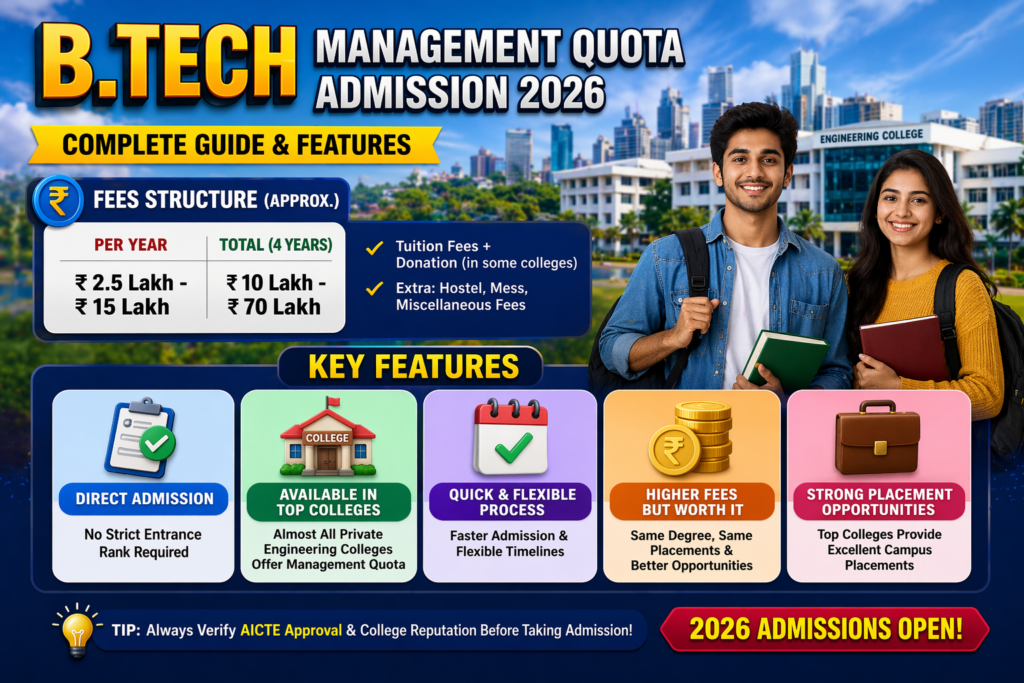
Btech Admission Through Management Quota Fees 2026
What Is Management Quota in BTech Admissions?
Management quota is a fixed percentage of seats — typically 15% to 30% of total intake — reserved by private engineering colleges for direct admission outside the regular merit-based counselling process. These seats allow institutions to admit students based on the college’s own criteria, offering families an alternative route to prestigious BTech programs even when JEE or state entrance scores fall short.
In 2026, with over 1.5 million students competing for engineering seats nationally, BTech management quota admissions have become an increasingly sought-after pathway to top-ranked private universities. Colleges like Manipal University, VIT Vellore, SRM University, and Amrita University continue to attract thousands of applications under this category every year.
Key Insight: Management quota seats are fully legal, AICTE-approved, and backed by institutional policy. Every college listed on btech-seats.com is verified with active regulatory approvals. Learn about our verification process →
Btech Admission Through Management Quota Fees 2026
Eligibility Criteria for Management Quota 2026
While criteria differ by institution, the general eligibility requirements for BTech management quota admissions in 2026 are as follows:
1- 10+2 Qualification
Minimum 45%–60% aggregate in Physics, Chemistry, and Mathematics (PCM) from a recognised board. Some colleges accept Biology instead of Mathematics for Biotech branches.
2 Age Requirement
Candidate must be at least 17 years of age as of December 31, 2026.
3 Entrance Score (College-Specific)
JEE Main score is preferred but often not mandatory. Many colleges conduct their own entrance tests (MET, VITEEE, SRMJEEE) or offer direct admission based on Class 12 marks.
4 Document Submission
Valid 10th and 12th marksheets, character certificate, migration certificate, and valid government ID are required during final admission.
Top Colleges Offering BTech Management Quota Seats 2026
Below is our verified list of top private engineering colleges offering BTech management quota seats in 2026. Colleges are categorised by tier for easier planning. Btech Admission Through Management Quota Fees 2026
🏆 Tier 1 — Premium
- BITS Pilani
- Manipal University
- VIT Vellore
- RV College of Engineering
- BMS College of Engineering
- PES University
- Thapar University
- Shiv Nadar University
⭐ Tier 2 — Strong
- SRM University
- Amrita University
- MS Ramaiah University
- Dhirubhai Ambani Institute
- NIRMA University
- Symbiosis Institute of Technology
- KIIT University (Kalinga)
- LNM Jaipur (LNMIIT)
🎓 Tier 3 — Value
- MIT WPU Pune
- PICT Pune
- KJ Somaiya Mumbai
- VIT Pune
- DY Patil Pune
- Narsee Monjee Institute
- SRMVIT
- REVA University
📚 Tier 4 — Accessible
- Galgotias University
- Amity University Delhi
- Jain University
- Christ University
- Alliance University
- KIET Ghaziabad
- ABES Engineering
- JSS Noida
Complete College Comparison Table — Management Quota 2026
| # | College | City | Approx. MQ Fees/Year | Tier | Details |
|---|---|---|---|---|---|
| 1 | BITS Pilani | Pilani / Goa / Hyd | ₹4.5L – ₹5.5L | Tier 1 | View → |
| 2 | Manipal University | Manipal / Jaipur / Dubai | ₹3.5L – ₹5L | Tier 1 | View → |
| 3 | VIT Vellore | Vellore / Chennai | ₹3L – ₹4.5L | Tier 1 | View → |
| 4 | RV College of Engineering | Bangalore | ₹2.5L – ₹4L | Tier 1 | View → |
| 5 | BMS College of Engineering | Bangalore | ₹2L – ₹3.5L | Tier 1 | View → |
| 6 | PES University | Bangalore | ₹4L – ₹6L | Tier 1 | View → |
| 7 | MS Ramaiah University | Bangalore | ₹2.5L – ₹4L | Tier 1 | View → |
| 8 | Thapar University | Patiala | ₹3.5L – ₹5L | Tier 1 | View → |
| 9 | KIIT University (Kalinga) | Bhubaneswar | ₹2.5L – ₹4L | Tier 2 | View → |
| 10 | Shiv Nadar University | Greater Noida | ₹3.5L – ₹5L | Tier 1 | View → |
| 11 | SRM University | Chennai / Delhi NCR | ₹2.5L – ₹4L | Tier 2 | View → |
| 12 | Amrita University | Coimbatore / Bangalore | ₹2.5L – ₹4L | Tier 2 | View → |
| 13 | Dhirubhai Ambani Institute | Gandhinagar | ₹3L – ₹5L | Tier 2 | View → |
| 14 | NIRMA University | Ahmedabad | ₹2.5L – ₹4L | Tier 2 | View → |
| 15 | Symbiosis Institute of Technology | Pune | ₹3L – ₹5L | Tier 2 | View → |
| 16 | MIT WPU Pune | Pune | ₹2L – ₹3.5L | Tier 3 | View → |
| 17 | PICT Pune | Pune | ₹1.5L – ₹2.5L | Tier 3 | View → |
| 18 | KJ Somaiya | Mumbai | ₹2L – ₹3L | Tier 3 | View → |
| 19 | Bharati Vidyapeeth Mumbai | Mumbai | ₹1.5L – ₹2.5L | Tier 3 | View → |
| 20 | JSS Noida | Noida | ₹1.5L – ₹2.5L | Tier 3 | View → |
| 21 | Galgotias University | Greater Noida | ₹1.2L – ₹2L | Tier 4 | View → |
| 22 | Maharaja Agrasen Institute | Delhi | ₹1L – ₹1.8L | Tier 4 | View → |
| 23 | Ajay Kumar Garg Engineering | Ghaziabad | ₹1L – ₹1.8L | Tier 4 | View → |
| 24 | KIET Ghaziabad | Ghaziabad | ₹1.2L – ₹2L | Tier 4 | View → |
| 25 | ABES Engineering | Ghaziabad | ₹1L – ₹1.8L | Tier 4 | View → |
| 26 | BVP New Delhi | Delhi | ₹1L – ₹1.8L | Tier 4 | View → |
| 27 | BPIT Delhi | Delhi | ₹1L – ₹1.8L | Tier 4 | View → |
| 28 | GNIOT Greater Noida | Greater Noida | ₹1L – ₹1.5L | Tier 4 | View → |
| 29 | Dayananda Sagar University | Bangalore | ₹1.5L – ₹2.5L | Tier 3 | View → |
| 30 | REVA University | Bangalore | ₹1.5L – ₹2.5L | Tier 3 | View → |
| 31 | NITTE Meenakshi | Bangalore | ₹2L – ₹3L | Tier 3 | View → |
| 32 | SRMVIT | Andhra Pradesh | ₹2L – ₹3.5L | Tier 3 | View → |
| 33 | DY Patil Pune | Pune | ₹2L – ₹3.5L | Tier 3 | View → |
| 34 | Sinhgad College of Engineering | Pune | ₹1.2L – ₹2L | Tier 4 | View → |
| 35 | Bangalore Institute of Technology | Bangalore | ₹1.5L – ₹2.5L | Tier 3 | View → |
| 36 | University of Petroleum (Dehradun) | Dehradun | ₹2.5L – ₹4L | Tier 2 | View → |
| 37 | RVITM Bangalore | Bangalore | ₹1.5L – ₹2.5L | Tier 3 | View → |
| 38 | RV University | Bangalore | ₹2L – ₹3.5L | Tier 3 | View → |
| 39 | BMSIT Bangalore | Bangalore | ₹1.5L – ₹2.5L | Tier 3 | View → |
| 40 | JL Bajaj Institute | Delhi | ₹1L – ₹2L | Tier 4 | View → |
| 41 | Vivekananda Institute (Delhi) | Delhi | ₹1L – ₹2L | Tier 4 | View → |
| 42 | LNMIIT Jaipur | Jaipur | ₹2.5L – ₹4L | Tier 2 | View → |
| 43 | VIT Pune | Pune | ₹1.5L – ₹2.5L | Tier 3 | View → |
| 44 | Narsee Monjee Institute | Mumbai | ₹2L – ₹3.5L | Tier 3 | View → |
| 45 | Cummins College | Pune | ₹1.5L – ₹2.5L | Tier 3 | View → |
| 46 | Amity University Delhi | Noida | ₹2.5L – ₹4L | Tier 3 | View → |
| 47 | Christ University | Bangalore | ₹2L – ₹3.5L | Tier 3 | View → |
| 48 | Jain University | Bangalore | ₹1.5L – ₹3L | Tier 3 | View → |
| 49 | MS Ramaiah Institute of Applied Sciences | Bangalore | ₹2L – ₹3.5L | Tier 3 | View → |
| 50 | Alliance University | Bangalore | ₹1.5L – ₹2.5L | Tier 3 | View → |
* Fee ranges are approximate and subject to change. View detailed fee structure → Btech Admission Through Management Quota Fees 2026
How to Apply — Step-by-Step Process
Applying for BTech management quota admission in 2026 is straightforward when guided by experts. Here is our recommended process: Btech Admission Through Management Quota Fees 2026
1
Shortlist Your Colleges
Based on budget, branch preference, location, and placement record. Use our college selector tool to narrow down options.
2
Verify Management Quota Availability
Contact btech-seats.com to confirm real-time seat availability. Management quota seats fill up quickly — particularly in CS, AI/ML, and ECE branches.
3
Document Preparation
Gather 10th & 12th marksheets, transfer certificate, migration certificate, passport photos, and government ID. Check our documents checklist →
4
Application & Spot Round
Submit application directly through the college or via btech-seats.com. Attend spot round or direct counselling as scheduled.
5
Fee Payment & Seat Confirmation
Pay the first-year fee (or seat booking amount) to confirm admission. Collect the official admission letter immediately.
Popular BTech Branches Under Management Quota 2026
Demand for seats varies significantly by branch. Based on 2025 data and 2026 early trends, here are the most sought-after BTech branches under management quota:
| Branch | Demand Level | Average Package (Top 10 Colleges) | Seats Availability |
|---|---|---|---|
| Computer Science Engineering (CSE) | 🔴 Very High | ₹12L – ₹25L | Limited |
| AI & Machine Learning | 🔴 Very High | ₹14L – ₹28L | Limited |
| Data Science | 🟠 High | ₹10L – ₹22L | Moderate |
| Electronics & Communication (ECE) | 🟠 High | ₹8L – ₹18L | Moderate |
| Mechanical Engineering | 🟡 Moderate | ₹6L – ₹14L | Available |
| Civil Engineering | 🟢 Low | ₹5L – ₹12L | Good Availability |
Btech Admission Through Management Quota Fees 2026