
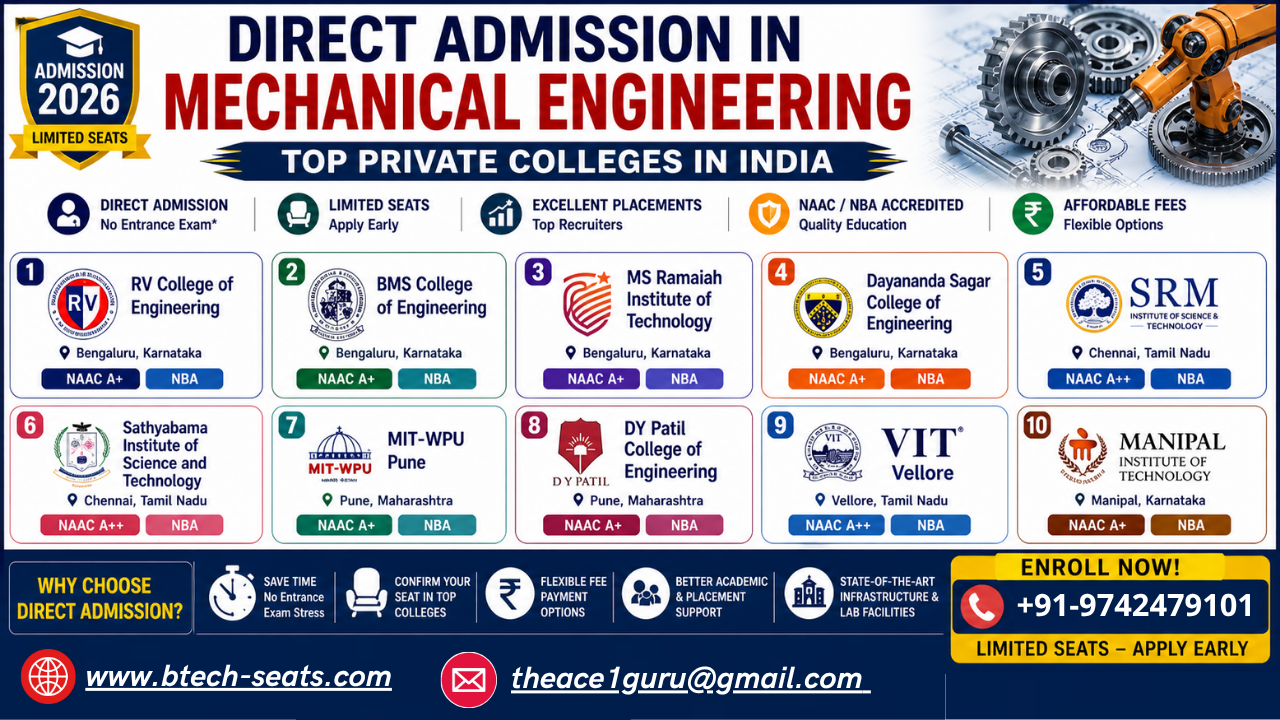
Direct Admission in Mechanical Engineering Colleges Without Entrance Exams
A Complete Guide for Students Seeking Management Quota, NRI, and Lateral Entry Admissions
Mechanical Engineering remains one of the most evergreen and versatile branches in engineering. From automobiles and aerospace to robotics and manufacturing, it forms the backbone of industrial development. While many students aim to secure admission through competitive entrance exams, not everyone gets their desired rank. This is where direct admission in Mechanical Engineering becomes a practical and widely used alternative.
In this detailed guide, we will explore everything you need to know about direct admission in Mechanical Engineering, including entrance exams, eligibility criteria, admission routes, top colleges, fee structure, and expert tips.
B.Tech Mechanical Engineering Highlights
In the following table, we have provided highlights of the B.Tech Mechanical Engineering Course, below the details shall help you to know the important information before getting admission into BTech Mech. Admission 2026.
|
Course Origin |
Engineering |
|
Course / Degree Type |
Undergraduate |
|
Duration of the Course |
4 Years |
|
Full Name |
Bachelor in Mechanical Engineering |
|
Admission Process |
Entrance Exams / Merit / Direct |
|
Minimum Marks Required |
50% |
|
Academic Eligibility |
10+2 (Intermediate) with Physics, Chemistry, and Mathematics |
|
Top Entrance Exam |
JEE Main 2026 |
|
Course Fee |
Rs. 85000 to Rs. 2,50,000/-* |
|
Leading recruiting companies |
Maruti Suzuki, Honda, BPCL, Coal India, ISRO, Mahindra, TVS, GE, DRDO, GAIL, others. |
|
Starting Salary |
Rs. 3 lacs to Rs. 10 lacs |
|
Job Position |
Jr. Mechanical Engineer, Sr. Mechanical Engineer, Design Engineer, Mechanical Design Engineer, Project Manager in Mechanical Engineering, Production Engineer etc. |
📞Call us at: +9742479101 |✉ Email: theace1guru@gmail.com | 🌐 Website: btech-seats.com
Expert Management Quota Counselling | Personalized guidance | End-to-end admission support
About Direct Admission in Engineering?
Direct admission refers to the process by which a student gains entry into an engineering program without appearing for or qualifying for a national or state-level entrance examination. Instead, admission is granted based on merit in Class 12 board examinations, management or NRI quota allocations, lateral entry based on a diploma, or through institutional aptitude tests conducted by the college itself.
It is important to note that direct admission is not a shortcut or a compromise on quality — many students who take the direct admission route go on to build outstanding careers in mechanical engineering, manufacturing, automotive, aerospace, and allied industries.
Entrance Exams for Admission in B. Tech in Mechanical Engineering
1. National Entrance Exams
➥ JEE MAIN – JEE MAIN is the top and best entrance exam to get admission in the B.Tech Mechanical Engineering course in top engineering colleges and universities in India.
➥ JEE Advanced – To study B. Tech in Mechanical Engineering in IITs and NITs, the JEE ADVANCED entrance exam is mandatory to clear with a good rank.
➥ CUET – The Common University Entrance Test (CUET – UG ) entrance exam is also accepted by many central universities in India for admission in B. Tech in the Mechanical Engineering Branch.
2. State Entrance Exams
Some state-level engineering entrance exams help students to get admission in B. Tech in the Mechanical Engineering branch. Like:
➥ COMEDK – Consortium of Medical, Engineering and Dental Colleges of Karnataka Undergraduate Entrance Test
➥ MHT CET – Maharashtra Common Entrance Test
➥ TS EAMCET – Telangana State Engineering, Agriculture, and Medical Common Entrance Test
➥ AP EAMCET – Andhra Pradesh Engineering, Agriculture and Medical Common Entrance Test
➥ TNEA – Tamil Nadu Engineering Admission Exam
➥ WB JEE – West Bengal Joint Entrance Exam
3. Private Entrance Exams
Some of the top universities in India conduct their own engineering entrance examinations to provide admission in B. Tech in the Mechanical Engineering Branch. Such as :
➥ VITEEE – VIT Engineering Entrance Exam
➥ BITSAT – Birla Institute of Technology and Science Admission Test
➥ SRMJEEE – SRM Joint Engineering Entrance Examination
➥ UPESEAT – University of Petroleum & Energy Studies Engineering Aptitude Test
➥ HITSEEE – Hindustan Institute of Technology and Science Engineering Entrance Examination
➥ MET – Manipal Entrance Test
➥ VTUEEE – Vel Tech Undergraduate Engineering Entrance Exam
➥ KIITEE – Kalinga Institute of Industrial Technology Entrance Examination
4. Direct Admission Process
Colleges also offer Direct admission in B. Tech in the Mechanical Engineering branch through various quotas. If a student has not acquired a good rank in engineering entrance exams, then direct admission is always a good option to explore for admission in B. Tech in Mechanical Engineering. However, the process if not easy. So, it is always recommended to get in touch with a reputed education consultancy for admission in B. Tech in Mechanical Engineering course for hassle free admission process.
Types of Direct Admission in Mechanical Engineering
1. Management Quota Admission
Management quota is a category of seats that private engineering colleges are permitted to fill at their discretion, outside of the state or national merit list. Typically, 15% to 20% of total seats in a private college are reserved under management quota. Admission through this route does not require JEE scores. Instead, colleges may conduct their own brief aptitude tests or grant admission purely based on Class 12 marks and an interview.
Key Features:
- No JEE Main or state CET scores required
- Based on Class 12 PCM (Physics, Chemistry, Mathematics) marks
- Higher fee structure compared to merit-based seats
- Seats are limited and filled on a first-come, first-served basis in many institutions
- Requires a formal application directly to the college
2. NRI Quota Admission
NRI (Non-Resident Indian) quota seats are available in most private engineering colleges under AICTE guidelines. These seats are meant for students who are NRIs or whose parents or guardians are NRIs. However, in practice, some institutions also allow resident Indian students to apply under NRI quota if the seats remain unfilled, though this varies by institution and state regulations.
Key Features:
- Fees are typically charged in US Dollars or at a higher rupee equivalent
- No entrance exam required in most cases
- Admission based on Class 12 academic record and a sponsored declaration
- Students must have a valid NRI sponsor (usually a close relative)
3. Lateral Entry for Diploma Holders
Lateral entry is one of the most legitimate and widely used routes for direct admission into the second year (3rd semester) of a B.Tech Mechanical Engineering program. Students who have completed a 3-year Diploma in Mechanical Engineering or a related stream are eligible. Most states have dedicated lateral entry entrance exams (like JELET in West Bengal, AP PECET, or TANCET), but several private colleges also offer direct lateral entry admissions based on diploma marks alone.
Key Features:
- Applicable only for diploma holders in engineering/technology
- Admitted directly to the 2nd year of B.Tech, saving one academic year
- Some private colleges do not require lateral entry exam scores
- Eligibility: Minimum 45%–60% marks in Diploma (varies by college)
4. Institutional Aptitude Tests
Some colleges, particularly deemed universities and private institutes, conduct their own entrance-level aptitude tests that are far less competitive than JEE. These tests primarily check basic aptitude, reasoning, and knowledge of PCM at the Class 12 level. Since these are institutional tests (not national exams), the competition is far lower and preparation is minimal.
Key Features:
- Conducted by individual institutions
- Far easier than JEE or state CETs
- Results declared quickly; admission process is faster
- Available in many Tier-2 and Tier-3 cities
5. Board Merit-Based Direct Admission
Several private colleges and deemed universities directly admit students based solely on their Class 12 board examination scores in Physics, Chemistry, and Mathematics. There is no separate entrance test involved. Students who score above a specified threshold (often 60%–70% in PCM) are offered direct admission.
Key Features:
- Strictly based on board exam performance
- Common in private colleges in states like Maharashtra, Karnataka, Tamil Nadu, Rajasthan, and UP
- Simple documentation-based process
- No entrance exam at any level
Mechanical Engineering Direct Admission Process 2026
Direct admission in Mechanical Engineering allows students to secure a seat in top private engineering colleges without depending entirely on entrance exam ranks like Joint Entrance Examination Main. This process is widely available through management quota, institute-level exams, and merit-based admissions.
Step 1: Research & Shortlist Colleges
Start by identifying suitable colleges based on:
- Accreditation (AICTE approval, NAAC grade)
- Placement records (core + IT companies)
- Fee structure (tuition + hostel)
- Location and campus facilities
Popular choices include RV College of Engineering, BMS College of Engineering, MS Ramaiah Institute of Technology, and Vellore Institute of Technology.
Step 2: Check Eligibility Criteria
Basic eligibility for 2026:
- Pass Class 12 with Physics, Chemistry, Mathematics
- Minimum 45–60% aggregate (varies by college)
- English as a compulsory subject
Some colleges may ask for a valid score in exams like Joint Entrance Examination Main or state CET (even low scores are acceptable for eligibility).
Step 3: Choose Admission Route
You can apply through:
- Management Quota – Direct seat allocation (higher fees)
- Institute-Level Exams – e.g., VIT Engineering Entrance Examination, SRM Joint Engineering Entrance Examination
- Merit-Based Admission – Based on Class 12 marks
- Spot Admission – For vacant seats after counselling
Step 4: Apply to Colleges
- Fill application form (online/offline)
- Pay application fee
- Submit academic details
Apply to 5–8 colleges to increase your chances.
Step 5: Contact the Ace Guru Education Services Office
Reach out to official college admission offices:
- Confirm seat availability in Mechanical Engineering
- Ask about the management quota/NRI quota
- Request fee structure and admission guidelines
Avoid unauthorized agents—always verify through official sources.
Step 6: Document Verification
Prepare the following documents:
- Class 10- & 12-mark sheets
- Transfer Certificate (TC)
- Migration Certificate (if required)
- Aadhaar Card / ID proof
- Passport-size photographs
- Entrance exam scorecard (if available)
Step 7: Counselling / Interview
Some colleges may conduct:
- Basic counselling session
- Personal interview
- Simple aptitude test
This is usually informal and focuses on your interest in Mechanical Engineering.
Step 8: Fee Payment & Seat Confirmation
- Pay admission/seat booking fee (₹25,000 – ₹1,00,000+)
- Confirm your seat within the deadline
- Collect official admission letter and receipt
Step 9: Final Reporting & Enrollment
- Report to the college campus
- Submit original documents
- Complete hostel and academic registration
- Receive student ID and timetable
Top Colleges to Study B. Tech in Mechanical Engineering via Direct Admission
|
Category |
College Name |
Location |
Admission Mode |
|---|---|---|---|
|
Karnataka Colleges |
RV College of Engineering |
Bangalore |
Management Quota / KCET / COMEDK |
|
Karnataka Colleges |
BMS College of Engineering |
Bangalore |
Management Quota / KCET / COMEDK |
|
Karnataka Colleges |
MS Ramaiah Institute of Technology |
Bangalore |
Management Quota / KCET / COMEDK |
|
Karnataka Colleges |
Dayananda Sagar College of Engineering |
Bangalore |
Management Quota / KCET / COMEDK |
|
Tamil Nadu Colleges |
SRM Institute of Science and Technology |
Chennai |
SRMJEEE / Direct Admission |
|
Tamil Nadu Colleges |
Sathyabama Institute of Science and Technology |
Chennai |
University Exam / Direct Admission |
|
Maharashtra Colleges |
MIT-WPU Pune |
Pune |
Merit-Based / Direct Admission |
|
Maharashtra Colleges |
DY Patil College of Engineering |
Pune |
MHT CET / Direct Admission |
|
Deemed Universities |
VIT Vellore |
Vellore |
VITEEE / Counseling |
|
Deemed Universities |
Manipal Institute of Technology |
Manipal |
MET / Counseling |
Fee Structure for Direct Admission
One of the most important considerations for direct admission is the cost involved. Management quota and NRI quota admissions carry higher tuition fees compared to merit-based admissions.
Approximate Annual Fee Ranges (B.Tech Mechanical Engineering):
|
Category |
Annual Fee Range (INR) |
|---|---|
|
Government colleges (merit) |
₹20,000 – ₹80,000 |
|
Private colleges (merit quota) |
₹80,000 – ₹1,50,000 |
|
Private colleges (management quota) |
₹1,50,000 – ₹4,00,000 |
|
Deemed universities (management quota) |
₹2,00,000 – ₹6,00,000 |
|
NRI quota (per year) |
₹5,00,000 – ₹15,00,000 |
Students should also account for hostel fees, examination fees, library and lab charges, and other incidentals, which can add ₹1,00,000 to ₹2,00,000 annually, depending on the college.
B.Tech Mechanical Engineering Syllabus 2026
| Semester I | Semester II |
| Applied Mathematics I | Advanced Physics |
| Engineering Physics | Material Chemistry |
| Engineering Chemistry | Engineering Mechanics |
| Basic Electrical Engineering | Advanced Electrical Engineering |
| Basic Civil Engineering | Engineering Graphics II |
| Engineering Graphics | Applied Mathematics II |
| Semester III | Semester IV |
| Applied Mathematics III | Applied Mathematics IV |
| Kinematics of Machines | Engineering Thermodynamics |
| Fluid Mechanics | Hydraulics Machines |
| Manufacturing Process | Machining Process |
| Engineering Metallurgy | Mechanics of Materials |
| Semester V | Semester VI |
| Industrial Economics | Energy Conversion I |
| Design of Machine Element | Control System Engineering |
| Advanced Production Process | Operations Research |
| Heat Transfer | Mechatronics |
| Mechanical Measurement and Metrology | Dynamics of Machines |
| Semester VII | Semester VIII |
| Industrial Engineering | Industrial Management |
| Automobile Engineering | Computer Integrated Manufacturing |
| Computer-Aided Design | Advanced IC Engine |
| Energy Conversion II | Automation in Production |
| Design of Mechanical Drives | Energy Conversion III |
Future Scope after B.Tech in Mechanical Engineering
There is a broad range of industries that provide fruitful career opportunities to B. Tech in Mechanical Engineering graduates.
|
Category |
Details |
|---|---|
|
Key Industries |
Automobile Industry, Space Research & Development Organizations, Aerospace Companies, Energy Sector, Infrastructure & Construction, Indian Railways, Indian Navy, Army & Air Force, Public Works Department (PWD), Robotics, Information Technology, Healthcare Sector |
|
Global Demand |
Industries worldwide require skilled mechanical engineers for diverse technical and operational roles |
|
Work Scope |
Design and manufacturing of microchips, semiconductors, turbines, excavators, cranes, and large-scale industrial machinery |
|
Job Roles |
Highly technical and innovative engineering positions across core and interdisciplinary sectors |
|
Salary & Growth |
Attractive starting salaries with consistent growth based on experience and skills |
|
Career Suitability |
Ideal for students interested in machines, innovation, and understanding operational mechanisms |
|
Career Scope |
Strong and promising future with opportunities in both core engineering and emerging technology fields |
Common Job Roles
● Mechanical Engineer: Designs, develops, and improves mechanical systems used in industrial and manufacturing environments.
● Design Engineer: Creates product designs and mechanical components using CAD and simulation tools.
● Production Engineer: Manages manufacturing processes to improve efficiency, quality, and productivity.
● Automotive Engineer: Works on vehicle design, testing, and performance optimisation in the mobility sector.
● Robotics Engineer: Develops automated machines and robotic systems used in smart manufacturing and Industry 4.0 environments.
Industries Hiring Mechanical Engineers
Mechanical engineers play an important role in several technology-driven sectors, including:
● Automotive Manufacturing: Designing vehicles, engines, and mobility technologies.
● Aerospace Engineering: Developing aircraft systems and advanced aerospace components.
● Energy and Power Generation: Working on power plants, renewable energy systems, and energy infrastructure.
● Robotics and Automation: Building intelligent machines and automated industrial systems.
● Heavy Engineering and Infrastructure: Supporting large-scale industrial machinery, construction equipment, and infrastructure development.
As industries increasingly adopt automation, smart manufacturing, and sustainable engineering technologies, mechanical engineers continue to play a key role in driving innovation and industrial growth in India and globally.
How Can We Help You?
We at Ace Guru Education Service understand students’ stress and difficulties while applying for courses in top colleges because of the increased competition. We help students improve their chances of admission to their preferred courses in top colleges. We provide admission assistance, guidance, and counseling for student increases to top colleges and universities in India.
📞Call us at: +9742479101 |✉ Email: theace1guru@gmail.com | 🌐 Website: btech-seats.com
Expert Management Quota Counselling | Personalized guidance | End-to-end admission support
More Blogs-
- Top Engineering Colleges in Bangalore with Direct Admission 2026
- BMS College Placements 2026
- RVCE NRI Quota Fees & Admission Process 2026‑27
- Top 50 Engineering Colleges for Management Quota Admission
- Direct Admission in SRM Institute of Science and Technology
- Management Quota Engineering Admission in Top Engineering Colleges
- What Is The Process For Getting A B-tech Seat Through Management Quota in Bangalore
- Should You Take Direct Admission in Specialized Branches in Jaypee Noida?
- Dhirubhai Ambani Direct Engineering Admission
- MS Ramaiah Management Quota 2026 Fees Seats & Direct Admission
- Amrita Vishwa Vidyapeetham Self Sponsored Management Quota 2026
- How to Get Direct Admission to Thapar University 2026
- SRM University Institute of Technology Direct Admission 2026
- Direct Admission in Symbiosis Institute of Technology
- Manipal Institute of Technology Direct Engineering Admission 2026-27
- Direct Admission in Banasthali Vidyapith 2026
- Direct Admission in MIT WPU Pune B.Tech
- Management Quota at Shiv Nadar University 2026-27
- Direct Admission in Maharaja Agrasen Institute of Technology