
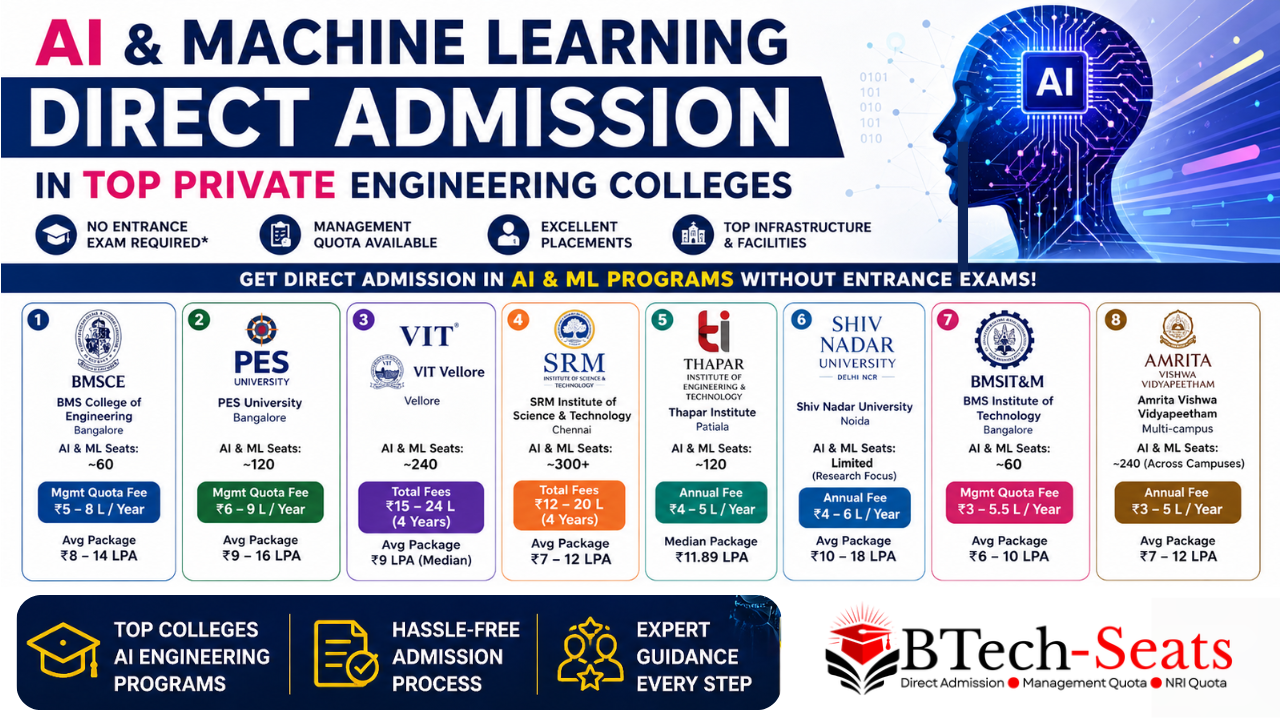
AI & Machine Learning Direct Admission in Top Private Engineering Colleges
Artificial Intelligence (AI) and Machine Learning (ML) have rapidly become the most sought-after engineering specializations in India. With the rise of automation, data science, robotics, and generative AI, students are increasingly choosing B.Tech in AI & ML over traditional branches.
However, admission to top engineering colleges through entrance exams like JEE Main, KCET, COMEDK, or MHT-CET is highly competitive. This is where direct admission through management quota or institutional quota becomes a practical alternative.
This comprehensive guide explains everything about AI & ML direct admission in top private engineering colleges, including eligibility, fees, top colleges, process, advantages, and key considerations.

📞Call us at: +9742479101 |✉ Email: theace1guru@gmail.com | 🌐 Website: btech-seats.com
Expert Management Quota Counselling | Personalized guidance | End-to-end admission support
Why AI & ML? Understanding the Career Imperative
The rationale for choosing AI & ML goes beyond salary figures, though those are compelling. Every industry — banking and fintech, automotive, healthcare diagnostics, edtech, retail, cybersecurity, and even government — is actively deploying AI-powered systems. The World Economic Forum estimates that AI will create 97 million new roles globally by 2025, displacing far fewer than it creates in net terms. In India specifically, companies like Google, Microsoft, Amazon, Infosys, TCS, Wipro, Zomato, and Paytm are the top recruiters from AI & ML departments of engineering colleges.
The curriculum of a B.Tech in AI & ML is structured to bridge theory and application. Core modules typically include machine learning algorithms, neural networks, deep learning architectures, natural language processing, computer vision, data structures, probability and statistics, Python and R programming, and cloud-based AI deployment. Students also undertake capstone projects, internships with tech firms, and participate in industry-sponsored research at leading colleges.
What is Direct Admission in AI & ML Engineering?
Direct admission refers to securing a B.Tech seat without going through centralized counselling or high entrance exam ranks. It is a legal and recognized pathway in private engineering colleges.
There are three main types:
➦ Management Quota Admission
- Colleges reserve 15–20% seats for direct admission
- Admission based on Class 12 marks or basic eligibility
- Higher fees than regular seats
➦ NRI / Institutional Quota
- For NRI/OCI students or institutional-level selection
- Flexible admission criteria
➦ College-Level Entrance / Direct Merit
- Some colleges conduct their own tests or merit-based admission
Top Colleges Offering AI & ML: Management Quota & Direct Admission
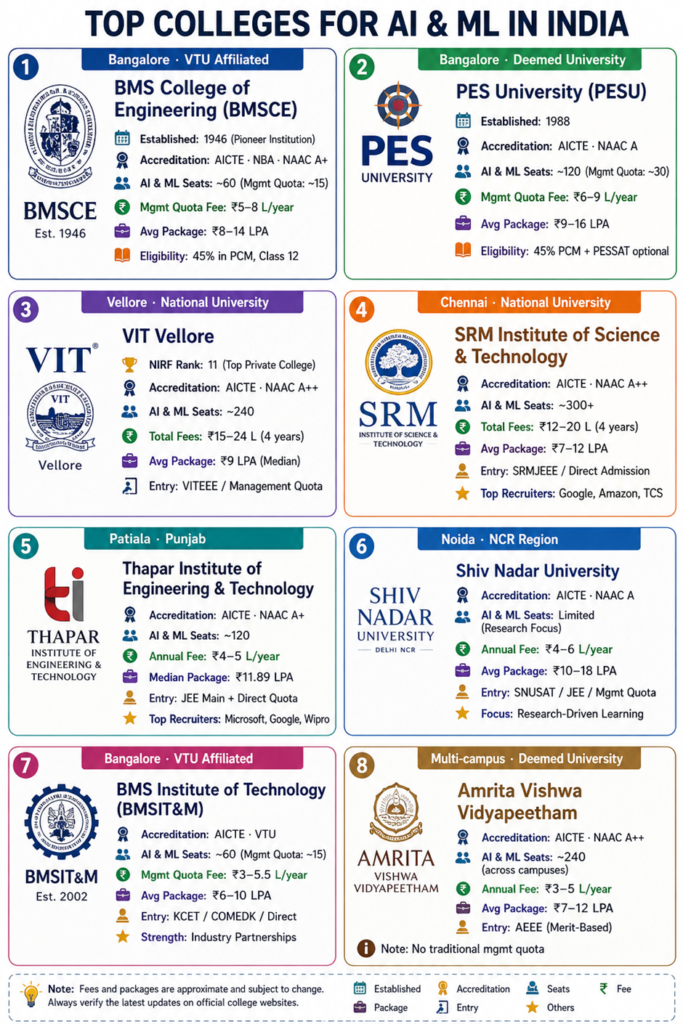
The following institutions are consistently regarded as the best private engineering colleges in India offering AI & ML programmes through a combination of merit-based counselling and management quota pathways. Fees listed are approximate annual figures for management quota seats and should be verified directly with admissions offices.
📞Call us at: +9742479101 |✉ Email: theace1guru@gmail.com | 🌐 Website: btech-seats.com
Expert Management Quota Counselling | Personalized guidance | End-to-end admission support
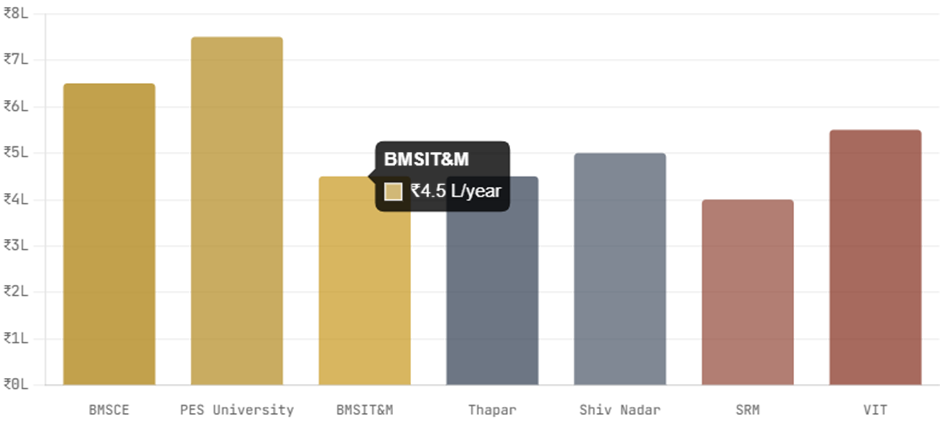
Management Quota Annual Fee Comparison — AI & ML (₹ Lakhs/year)
Eligibility Criteria: What You Need to Qualify
Management quota admissions are subject to minimum academic eligibility norms set by AICTE and state regulatory bodies. These are non-negotiable regardless of the institution or fee paid. The basic requirements are consistent across most private engineering colleges offering AI & ML:
|
Criterion |
Requirement |
Notes |
|---|---|---|
|
Class 12 Board Score |
Minimum 45% aggregate |
PCM (Physics, Chemistry, Mathematics) mandatory. Premium AI & ML seats may require 50–60%. |
|
Subjects in Class 12 |
Physics, Chemistry, Mathematics |
Computer Science is preferred but not mandatory in all colleges. |
|
Entrance Exam Score |
Optional (for most management quota) |
JEE Main / State CET scores may be considered for shortlisting. |
|
Age |
Minimum 17 years (by Dec 31) |
As per AICTE norms for B.Tech programs. |
|
Domicile |
No restriction |
Open to students from all states (unlike state quota seats). |
|
NRI Quota |
Passport + sponsorship proof required |
Separate quota with significantly higher fees in most private colleges. |
Also Read:
- MS Ramaiah Management Quota 2026 Fees Seats & Direct Admission
- Amrita Vishwa Vidyapeetham Self Sponsored Management Quota 2026
- How to Get Direct Admission to Thapar University 2026
- SRM University Institute of Technology Direct Admission 2026
- Direct Admission in Symbiosis Institute of Technology
- Manipal Institute of Technology Direct Engineering Admission 2026-27
- Direct Admission in Banasthali Vidyapith 2026
- Direct Admission in MIT WPU Pune B.Tech
- Management Quota at Shiv Nadar University 2026-27
- Direct Admission in Maharaja Agrasen Institute of Technology
The Direct Admission Process: Step by Step
The management quota admission process follows a broadly consistent structure across private engineering colleges in India. Understanding each stage allows students and families to plan timelines, gather documents in advance, and avoid last-minute complications. Application windows typically open in January and run through April, with most management seats being filled before regular counselling rounds conclude.
❶ Initial Research & Shortlisting
Identify 3–5 target colleges based on ranking, location, fee affordability, placement record, and NAAC/NBA accreditation. Verify that the institution is UGC/AICTE approved and offers a dedicated AI & ML programme — not merely a CSE programme with AI electives.
❷ Seat Availability Inquiry
Contact the college’s official admissions desk or management quota office to confirm available seats in the AI & ML branch. Management quota seats are limited (15–25% of intake) and fill rapidly in high-demand branches. Early inquiry is critical — ideally by January or February.
❸ Academic Profile Submission
Submit Class 10 and Class 12-mark sheets, any entrance exam scorecards (JEE Main, VITEEE, KCET, etc.), and a filled application form. Some colleges conduct a brief personal interview or academic verification call. JEE Main performance may provide shortlisting priority at institutions like Thapar.
❹ Offer Letter & Booking Fee
Once eligibility is confirmed and a seat is available, the college issues a provisional offer letter. Payment of a booking fee (typically ₹25,000–₹1,00,000) is required to reserve the seat. Always obtain an official receipt and written confirmation on college letterhead.
❺ Document Verification & Fee Payment
Visit the college in person or through authorised representatives for original document verification. Pay the first-year management quota fee as per the college’s schedule. Obtain all receipts and ensure the fee breakup (tuition, development, lab fees) is itemised and in writing.
❻ Admission Confirmation & Reporting
Receive the final admission letter and college registration details. Report to the college on the designated date with original documents. The admission is now confirmed; the student is enrolled in the B.Tech AI & ML programme for the 2026–27 academic session.
📞Call us at: +9742479101 |✉ Email: theace1guru@gmail.com | 🌐 Website: btech-seats.com
Expert Management Quota Counselling | Personalized guidance | End-to-end admission support
Fee Structures: Merit vs. Management Quota
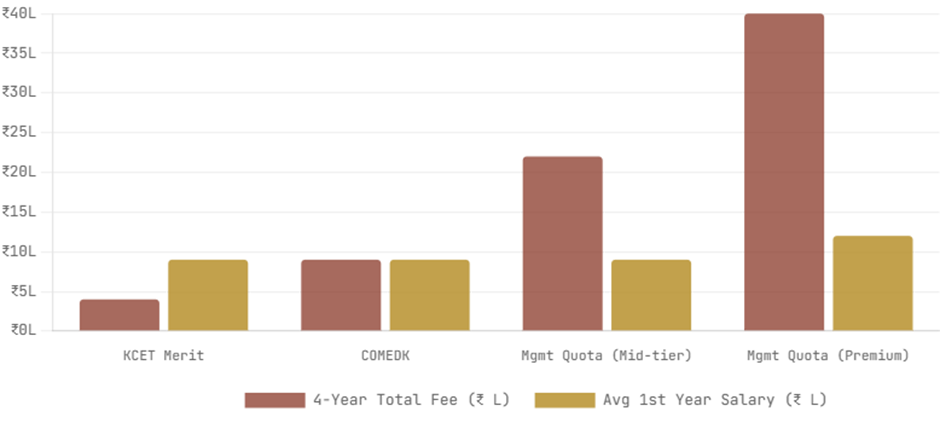
Understanding the fee differential between merit-based and management quota seats is essential for financial planning. The following comparison illustrates the gap across the three primary admission routes available to engineering aspirants in Bangalore, India’s largest private engineering hub:
|
Admission Route |
Annual Fee (Approx.) |
4-Year Total |
Eligibility Basis |
|---|---|---|---|
|
KCET / State Quota |
₹50,000 – ₹1.5 L |
₹2 – 6 L |
State entrance exam rank; Karnataka domicile required |
|
COMEDK / National Merit |
₹1.5 – 3 L |
₹6 – 12 L |
COMEDK UGET score; open to All India students |
|
Management Quota |
₹3.5 – 12 L |
₹14 – 48 L |
Minimum 45% PCM in Class 12; no strict entrance exam requirement |
|
NRI Quota |
USD 5,000 – 15,000 |
USD 20,000 – 60,000 |
NRI/PIO/OCI proof; passport and sponsorship documents required |
Return on Investment: Fee vs. Average Package (₹ Lakhs)
Documents Required for Management Quota Admission
Having documents ready in advance eliminates last-minute delays that can result in losing a reserved seat to another applicant. The following checklist covers the standard requirements across most private engineering colleges in India:
- Class 10-mark sheet and pass certificate (original + 4 photocopies)
- Class 12-mark sheet and pass certificate (original + 4 photocopies)
- JEE Main / VITEEE / KCET / SRMJEEE scorecard (if applicable)
- Aadhar card of student and parent/guardian
- Passport-size photographs (minimum 6, recent)
- Transfer Certificate (TC) from the last attended institution
- Migration Certificate (for students from boards outside the state)
- Caste/category certificate (if applicable, for any fee concessions)
- Income certificate (for scholarship consideration)
- Medical fitness certificate from a registered practitioner
- Anti-ragging undertaking (signed by student and parent)
- Demand Draft / confirmed fee payment receipt from the college
📞Call us at: +9742479101 |✉ Email: theace1guru@gmail.com | 🌐 Website: btech-seats.com
Expert Management Quota Counselling | Personalized guidance | End-to-end admission support
Career Scope and Placement Outcomes
AI & ML graduates from accredited private engineering colleges in India are recruited across a remarkably diverse range of sectors. The average starting salary for AI & ML graduates nationally ranges from ₹6–12 LPA, with top performers from leading colleges like VIT, BMSCE, PES University, Thapar, and Shiv Nadar University securing packages from ₹18–35 LPA at product-based companies.
The career pathways are equally varied. Graduates work as machine learning engineers, data scientists, AI research engineers, computer vision developers, NLP engineers, MLOps specialists, and AI product managers. Some choose postgraduate research at IITs, IIITs, or international universities; others found AI-focused startups. The industry alignment of top private colleges — through partnership labs, hackathons, and pre-placement offers during internships — is a significant differentiator that justifies the management quota premium for many families.
Frequently Asked Questions
Can I get B.Tech AI & ML admission without any entrance exam?
Yes. Most private engineering colleges accept management quota students on the basis of Class 12 PCM marks alone, with no mandatory entrance exam requirement. However, providing a JEE Main scorecard — even a modest one — can strengthen your application and is sometimes used to prioritise between applicants vying for the same seat.
Is the degree from a management quota seat valid and recognised?
Absolutely. If the college holds valid AICTE approval and is affiliated to a recognised university (VTU, Anna University, GGSIPU, etc.) or is a deemed university itself, the B.Tech degree carries identical recognition regardless of the admission route. Employers do not distinguish between merit quota and management quota graduates.
What is the minimum percentage required for management quota AI & ML admission?
The AICTE-mandated minimum is 45% aggregate in Physics, Chemistry, and Mathematics at Class 12 level (general category). Some premium institutions — particularly highly ranked autonomous colleges — may require 50% or higher in practice, especially for AI & ML which is in higher demand than most branches.
How many management quota seats are available in AI & ML?
Typically 15% to 25% of the sanctioned intake per programme is reserved under management quota. For a typical AI & ML batch of 60 seats, this means 9–15 management quota seats. For larger intakes of 120–240 (as at VIT or SRM), the absolute numbers are larger but competition within the quota is also higher.
When should I begin the management quota admission process?
Ideally, begin inquiry in January or February of your Class 12 board exam year. Application processes typically open in January, and management seats — especially in high-demand branches like AI & ML — are frequently exhausted before May or June counselling rounds begin. Waiting for your Class 12 results before inquiring risks finding all management seats occupied.
Is Bangalore or another city better for AI & ML management quota?
Bangalore remains India’s preferred destination for AI & ML engineering due to its concentration of top-tier institutions (BMSCE, PESU, RVCE, MSRIT), the presence of major tech company offices offering internship and placement pipelines, and a mature startup ecosystem. However, institutions in Chennai (VIT, SRM), Patiala (Thapar), and Noida (Shiv Nadar) also offer strong programmes with national-level placements.
📞Call us at: +9742479101 |✉ Email: theace1guru@gmail.com | 🌐 Website: btech-seats.com
Expert Management Quota Counselling | Personalized guidance | End-to-end admission support
Also Read:
- Top Engineering Colleges in Bangalore with Direct Admission 2026
- BMS College Placements 2026
- RVCE NRI Quota Fees & Admission Process 2026‑27
- Top 50 Engineering Colleges for Management Quota Admission
- Direct Admission in SRM Institute of Science and Technology
- Management Quota Engineering Admission in Top Engineering Colleges
- What Is The Process For Getting A B-tech Seat Through Management Quota in Bangalore
- Should You Take Direct Admission in Specialized Branches in Jaypee Noida?
- Dhirubhai Ambani Direct Engineering Admission